

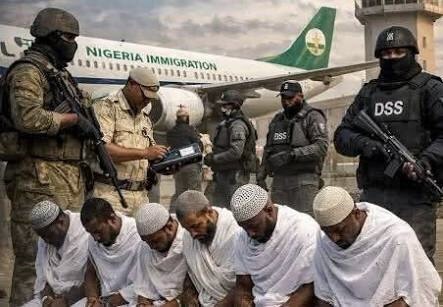
The atmosphere inside the international arrivals terminal at the Umaru Musa Yar’Adua International Airport in Katsina was one of celebration. Families stood behind security barriers waiting to embrace relatives returning from Saudi Arabia after completing the 2026 Hajj pilgrimage. Airport officials moved methodically through familiar administrative routines, and returning pilgrims wheeled their luggage toward the main arrival hall after presenting their travel documents for standard border clearance.
Then, without warning to the waiting crowd, the routine changed.
As passengers stepped forward one after another for immigration clearance, border control officers quietly isolated seven men from the rest of the arriving passengers. There was no public commotion, no shouting, and no dramatic confrontation inside the terminal. The men were discreetly separated from the other pilgrims, escorted out of public view under heavy security detail, and placed in immediate custody.
Within hours, the seven detainees were moved out of the airport under armed escort and subsequently flown to Abuja, where they were handed over to the State Security Service (SSS).
Days later, the Minister of Interior, Olubunmi Tunji-Ojo, made a public announcement that transformed the quiet airport operation into a subject of intense national debate. The minister stated that security agencies had intercepted seven suspected commanders of Boko Haram and ISWAP who had returned from the Hajj through the Katsina airport.
Nigeria faces several types of terrorism from groups like ISWAP, Boko Haram, and bandits. Several groups of bandits operate in Katsina, where thousands of people have been killed or kidnapped in recent years.
The government presented the arrests as evidence of Nigeria’s expanding digital border management capabilities, highlighting technical advancements in biometric identity verification and real-time intelligence coordination among security agencies.
As of the time of publishing this story, neither the federal government nor the SSS has publicly released the identities of the seven suspects or announced any criminal charges against them.
While the minister’s announcement generated major headlines across the country, it also left behind a series of fundamental questions. The most critical question raised by the operation is not how the men were apprehended upon their return, but how they managed to leave Nigeria in the first place.
